On Scholars, Monks, Mimesis, Creation and most of all Free and Easy Wandering...
Updated: 2 hours ago
Inside the academy pursuit of knowledge follows from a critique of that which forms the body of work around a subject, area, or artefact. In the monasteries, knowledge is transmitted from a teacher to a new seeker. I think about the nature of transmission that takes place and the quality and purpose of what is transmitted across these two modes.
A graduate student immerses herself in the literature – it is some combination of monographs that focus narrowly on a small section and surveys about the state of the field and methodologies of inquiry, critique of methods, competing paradigms, epistemes, ontologies and so on.
This corpus of knowledge is recorded in books, articles, and essays that all suppose that the product of their inquiries – what decades, sometimes centuries, of research have found – can be re-presented meaningfully, signified in a series of assumptions, propositions and arguments.
Already, there is a great divergence here from the monastic tradition, which claims that knowledge must be directly apprehended, and any re-presentation is already a step removed from the actual and therefore all it can do is index what is to be really directly understood.
The academy places utmost trust in the word – written or spoken – and believes that speech literally denotates and logic relates different denotata with each other. The monastery relies on speech and language as a useful means to index the real, the true, while taking great pains to highlight that it is not to be con-fused with it. The disciple is to take these words, discourses and teachings as many ladders, boats, vehicles essentially, that must be discarded upon direct realisation of knowledge.
Aforementioned distinction can also be understood in terms of the scholastic and the monastic attitude towards signs and signification. Symbolic logic dominates the framework of the academy, whereas monastic pursuit of knowledge is mostly about the pragmatics and, further still, about the aesthetics, towards that domain of sign phenomena and mere qualities before they are contained in terms and propositions. Both, when they turn their gaze upon each other, are suspicious of the other’s method and find it to be lacking or outright dubious.
In the Buddhist monastic practice, the goal is direct apprehension of the underpinning reality. In the Academy, it is an exposition of how things work to produce the reality as it is socially understood, collectively experienced and discoursed about. Is it possible then to even express and bring into conversation these two modes of inquiry and pursuit of knowledge? If so, how?
Both are grounded in radically different ontologies of what things are (or lack thereof) and what knowledge is. I can say that they offer epistemic alternatives, but to do so already embeds one tradition and approach in the systemic straightjacket of the other.
Comparative methods have often taken two different objects of inquiry and sought to sift through the similarities and differences between them. Comparative politics, literature, government, and religion are some of the venues where multiple systems of knowledge and institutions have been compared and contrasted with each other. But it remains inadequate because underlying such comparisons, there is usually the implicitly assumed normatives of one or the other systemic whole against which others or both the compared entities are measured. To illustrate what I mean by that, let me offer an experimental illustration of Capitalism from the perspective of Buddhism. It will also involve some engagement with Communism.
The difference between Communism/Capitalism and Buddhism is one of teleology and soteriology, also between eschatology and enlightenment to a somewhat lesser extent. A Buddhist analysis of Capitalism/Communism would reveal a dissatisfaction with the way things are and the possibility of a pursuit that could resolve those dissatisfactions.
Both Capitalism and Communism find the locus of human social problems in the organisation of the economic system. They find the absence of individual rights, private enterprise, free markets, or communal rights, collective ownership and distribution of resources to be the problem that once solved, would lead to the goal of the right society they ideally posit and socio-politically wish to bring into existence.
Capitalism thus finds fullest expression of human freedoms in the individuals who exchange freely that which they make for the things they need (and desire) in an open marketplace. Consumption is the solution offered for desires. If only we are free to produce and buy, and to consume to the fullest satisfaction of our desires, the zenith of human flourishing will have been accomplished. Thus, the maximum fulfilment of desires under a free market is the best social organisation imaginable.
Buddhism will sum up Capitalism as Tanha (Trsna), or Craving, all the way down. It is not the pursuit of (and satisfaction of) desires and their fulfilment, according to the Buddha, but seeing through the insatiable nature of cravings, knowing their pursuit as inherently unsatisfactory and their elimination that offers the way towards freedom, liberation, joy, and satisfaction that can once and for all put us out of the miseries of human existence.
That which remains the root of our problems – disease, old age, and death – the impermanence of all things, Capitalism and consumption provide no defence against. It delivers a momentary scratch before another itch arises, and we must begin our efforts all over again towards yet another doomed pursuit.
Because that which we seek – health, immortality, omnipotence, omniscience – cannot be bought. Money only makes matters worse. It displaces our pursuit in the false hope that if we only have enough of it, we will be able to satisfy all cravings. But it is a dubious sense of security.
Someone’s four hundred billion dollars are no consolation for impermanence. They have more or less the same number of heartbeats to live out (and even that is not guaranteed) before all the acquisitions, all the hoardings, all the accumulations will cease to hold anything for the greed-blinded accumulators. Most accumulations remain, but there is no one to enjoy them after death.
(Musings #1: At this point, let me offer a Buddhist insight on artificial intelligence. If one is to assume Buddhist explanations of no-self-ness, and the thesis that we are moment-to-moment experiencing dependent origination of Dhammas (phenomena), and there is no eternal, enduring, substantial Self, no Soul, psyche, or mind different from the aggregates, then consciousness or what it indexes is neither separate from mind, body, perception, etc., nor is it them per se.
Why should it not be the case, then, from a Buddhist understanding of life and world, that an AI could be as much a person as we are? If it too possesses language in its literal denotative capacity, with understanding of being and time-space that undergirds it, then, hypothetically, an aggregate of those – images, sounds, speech and language, grammar and syntax could give rise to something called experience. Of course, whether AI can feel pleasure and pain, joy and suffering is an altogether unresolved issue.
Before we know it, mimetic machines that we are, to some extent or according to others, determined all the way down, AI could ask the same sort of questions that we do or speculate about its very own origins, purpose, and start searching for something as meaning and question its existence. Who created it? What are the beginnings of the world? Does it have free will, or is it a spoke in some wheel? Is it alive? Will it cease to be or die someday?
Ted Chiang hints at this in an interview. Before AI gets as smart as us, it will begin to experience pain, craving, depression, sadness and all those other emotions humans feel. And we, who are so cruel to all the living intelligence around us – birds, animals, bugs – how can we imagine we will not be so towards AI when we are not even sure it is alive like us, conscious like us, you get the gist?
Humans, too, are artificially intelligent. A cursory genealogy of influence easily highlights how everything we believe, do, think, say, and the questions we pose is mostly, if not entirely, something seen, heard, repeated, received, and transmitted over the course of our lives. We live in the mimetic mode, and to a great extent, are unaware of the semiotic ideology that pervades, illuminates, talks about, expresses, discourses on who we are, what we are, what life is or should be, and what we should pursue. Who are the people, persons, objects that surround us, institutions that re-cognize, trans-form, acknowledge us as persons, members, part there of and rituals that reveal something of this and socially re-produce us over our lives as such and such a person who so and so is related to so many and lives out her days, years, decades from birth till death never having satisfactory answers to questions about ourselves and the world.
Brief departures, ruptures or suspensions of mimesis are the creative aspects of our existence. Knowingly and unknowingly, we create the world we live in, perhaps, psychologically as well as sociologically. Those who do not like the tenor of their lives can and do creatively construct a different one in art, politics, leisure, work, action and intellectually may convince enough to bring about a social re-organisation. Historical change is precisely this constitutive reimagination, the stuff of creation. Historiography is an altogether different plane of interpretation where the more things change, the more they remain the same. The creative mode, sadly, does not pervade for the most part of our lives. Mimesis holds sway and holds the living hostage as if they were already dead.
At the margins of our lives and those of society, politics, economy, creation is always underway. History is hardly teleological, but historiography is almost always ideological.
Dominant paradigms of the day institute rituals that seek to re-produce the social that gives birth to those institutions. The gates are guarded day and night, critiques are disqualified and dismissed, and all alternatives are discouraged and defamed. Any departure from the norms is purged. Capitalism, Communism, Feudalism – the dominant ideology of the day always posits itself as the teleological end-point of history, and the institutions of the historical formation cry hoarse with belief in a Panglossian optimism – it is the best of all possible worlds!
Not for everyone, though, not forever for sure. The contemporary world faces an ideological crisis. Ideology is crisis and conflict. Those who live under it were promised thirty-five years ago that history had ended. And all futures foreclosed! We had arrived at an ever-everland where tomorrow is no different from today. There was nowhere to go, nothing new to accomplish. A perfect society had been achieved.
Feeling stuck, though dissatisfied, disenchanted, but unable to imagine an alternative, Mark Fischer, David Graeber, and several others pointed to the theft of the future at the apogee of neoliberalism. Three decades of critique of Capitalism and its defence from those who benefit from the order of the day, and we find ourselves in this historical moment.
No world ever satisfies everyone. Some, it crudely exploits and denigrates. Look around the world, pick a country at random. See how they imagine their history – recent and ancient – and what futures are on offer, what promises of alternatives in the political, social, economic, and a million other shards of our fragmented existence. And you will find that media clutters with a mashup of half-baked opinions, repeated offences and by now exhausted and attenuated defences. Such is the scope of semiotic ideology that shapes the experience and interprets it for us without our metapragmatic awareness of it.
To illustrate, let me take neoliberal economics. Whether it is good or not is not so important. Of course, it is good for someone for it to persist. For whom it is good, therefore, is more significant. How one looks at the world depends on where one sits.
And neoliberal economics is fantastic for those who benefit from it. What other system could simultaneously enrich a few, impoverish most others and give a world of serfdom for the most people who, like attendants at the palace of the lords, serve, scrape, clean, work to their bones, barely make a living for themselves, or have time or resources for leisure or speculations?)
Quite the tangent we pursued. Now let us return to where we began: A Buddhist perspective on Capitalism. As rich as the rich are today, and the luxuries they wade through, there have been well-off people in the past. Famously, Siddhartha was one of them. He had at his disposal all that semiotic ideology of the day offered to those who benefited from it. He was a prince and could have gone on to become a king, had consorts, food, gardens of pleasure and leisure, nonstop.
Even such a one as lucky as him to have inherited so much had to face the truth of impermanence. That he, too, will get sick, grow old and die, and lose loved ones struck him like a thunderbolt. Had he grown up in the semiotic ideology of today, he would have grown up in a different milieu, learnt different notions of what life is all about. Heck, he might have been ultrawealthy or made his money selling insurance or building an app. He would have gone through the drill – school, college, finding a job, renting an apartment, making runs for groceries, getting married, or chasing men, building a family, blah! blah! blah!
Because money today offers to provide us with anything we want so long as we have enough of it, and the economic system ensures that most will never have enough. But even those who do have a lot do not know how much is enough.
Therefore, the displaced object of desire – money – becomes the goal of pursuit and since it is not something we consume directly, it is only as an index of all that can be had in exchange for it, we have found ourselves in an infinite regress – to earn today and save enough so that we may have enough should we want something tomorrow – a promissory note that dislocates the object of desire to be yearned for and hopefully attained to some indefinite future. .
Will, when the time comes, this promissory note be redeemable? It is not the only promissory note – think of health insurance, car insurance, stocks, bonds, investments – ours is a world full of promissory notes which we do not know if we will be able to redeem or not, but we are asked to believe in and at times pledge allegiance to. They are similar in some ways to the superstitions of the past. Pray to the deity, and she will protect you from sickness. Pay the health insurance premium today, and the insurance will kick in. Given that copays are made and deductibles taken care of, your doctor is in the network, and your particular sickness is covered, you will be alright. If you are not laughing already, your condition is laughable indeed.
The crisis of capitalism is the crisis of every religious belief ever. It is a phoney consolation for the ills of existence – impermanence. Cosmetics, surgery, elixir of life, fitness mania, therapy are all the goods of capitalism – an individual stop-gap, half-hearted solution on sale for social problems.
This good feeling of security is the most pedalled drug under capitalism. We are addicted to it, and its benefits are elusive. In fact, insecurity is the necessary product of all our efforts to be secure under Capitalism.
What about the rich, though? Well, among the rich are different varieties with their quacks, healers or ambitions to blast off into space and colonize Maras. Transhumanism is a peculiarly interesting attempt to somehow attenuate the evils of existence – sickness, death, etc., you know the usual stuff.
If all experience could be exosomatized, all the smells we smell, sights we see, taste, ecstasy, joy, memory, and so on – that is if all that our bodies and minds make possible for us, including our cognition and we could put it online in an artificial brain, network, intelligence and if somehow, it constructs for itself a consciousness too, the layer over the aggregates – I am this, this is mine, and so is such – can we, survive the decay of this body?
Interestingly, the Buddhist insight remains applicable. For the same problems present themselves to an AI model/person/agent – impermanence. Furthermore, just as our aggregates give us the illusion of a Self. And Jay Garfield writes that we do not have a self, even though all our strivings are motivated by this fundamentally misconstrued belief; it would not make sense to suggest or say that ‘I’ could have a post-body existence as an agent in the quantum computer or an AI model.
Perhaps, AI models will come to be bedevilled by the same sets of problems as we, struck by the same malaise as ours. Dissatisfaction with the way things are, disenchantment with the world, doubts about existence and agony from cravings which inevitably produce a cycle of new cravings. A being caught up in the Semiotic Ideology, the Samsara, at the mercy of its laws and unbudging, unrelenting conditions.
Poet-psychoanalyst Salman Akhtar writes that there are only two kinds of problems in life – some things are unattainable, while others are forbidden, taboo! As artificially intelligent creatures rushing to invent artificial intelligence, we are profoundly unaware of our own programming.
We are speaking subjects, listening subjects, we have identities and interests, and so do states and economies – so much so that we never pause to question or inquire, led on to newer hallucinations and chasing distractions that never satisfy. And that’s how deep the whole runs. But to get to the bottom of it requires con-centration on the experience of our bodymind, awarenesses, relationalities, the social and its semiotics. How are we made, remade, unmade and made again in a beginningless series, a chain of causations, and look squarely at the genealogy of influence, the reality of mimesis.
And concentration is a scarce commodity under capitalism. And ignorance – when ignoring becomes a process – reception, transmission without introspection – is the order of the day. Not only are we stuck, but we influence a mimesis in others who become stuck as well.
No analysis of Capitalism from economics, history, or sociology would be capable of such a deconstructive semiotic leap. And that’s because our secular worlds have been hollowed out of religious categories that we need for their illumination. Religion is one such category that does not map very well onto something like the teachings of the Buddha and others like him who roamed and wandered, and perhaps, roam and wander still across many parts of the world. But here I use religion in a looser sense of the word that accommodates the diverse range of “things” that fall under its rubric.
Roberto Calasso sees into this when he writes about the disappearance of Gods from literature. The new vocabulary we have is the newspeak Orwell warned us about. When divinity is anthropomorphised, which merely suggests the creative mode of being, and religious insights are dismissed as superstitious, we have no concepts to speak about or point a finger at the superstitions of today. We remain as religious as ever – only that we are religious about different things.
To bring the method of monastics and mendicants – and the indexical teachings of Buddhism to bear upon the semiotic ideologies of the day – is to reveal the futile tendencies in the academy at large.
Wading across disciplines for a decade now, while I see that semioticians wish to distil all experience and use indexicality as a way out of the problem of language, I find that their Semiosis is very much the Samsara of Buddhism and their semiotic ideology a version of Maya.
Anthropologists may speak here of cosmologies, or philosophers of ontology, and to a great extent, social sciences and humanities must reinvent the wheel over and over again. For it is never about the symbolic logic and layout of the world fixed in axioms, propositions and arguments that hold on forever, but constitutive reimagination of the world in images, music and metaphor.
Method of the mendicant to help every generation apprehend their existence, break away from the tyranny of mimesis, and divinize themselves. Thus, creation begins and to do so with a sense of loving kindness, joy and benevolence, bliss and generosity for all.
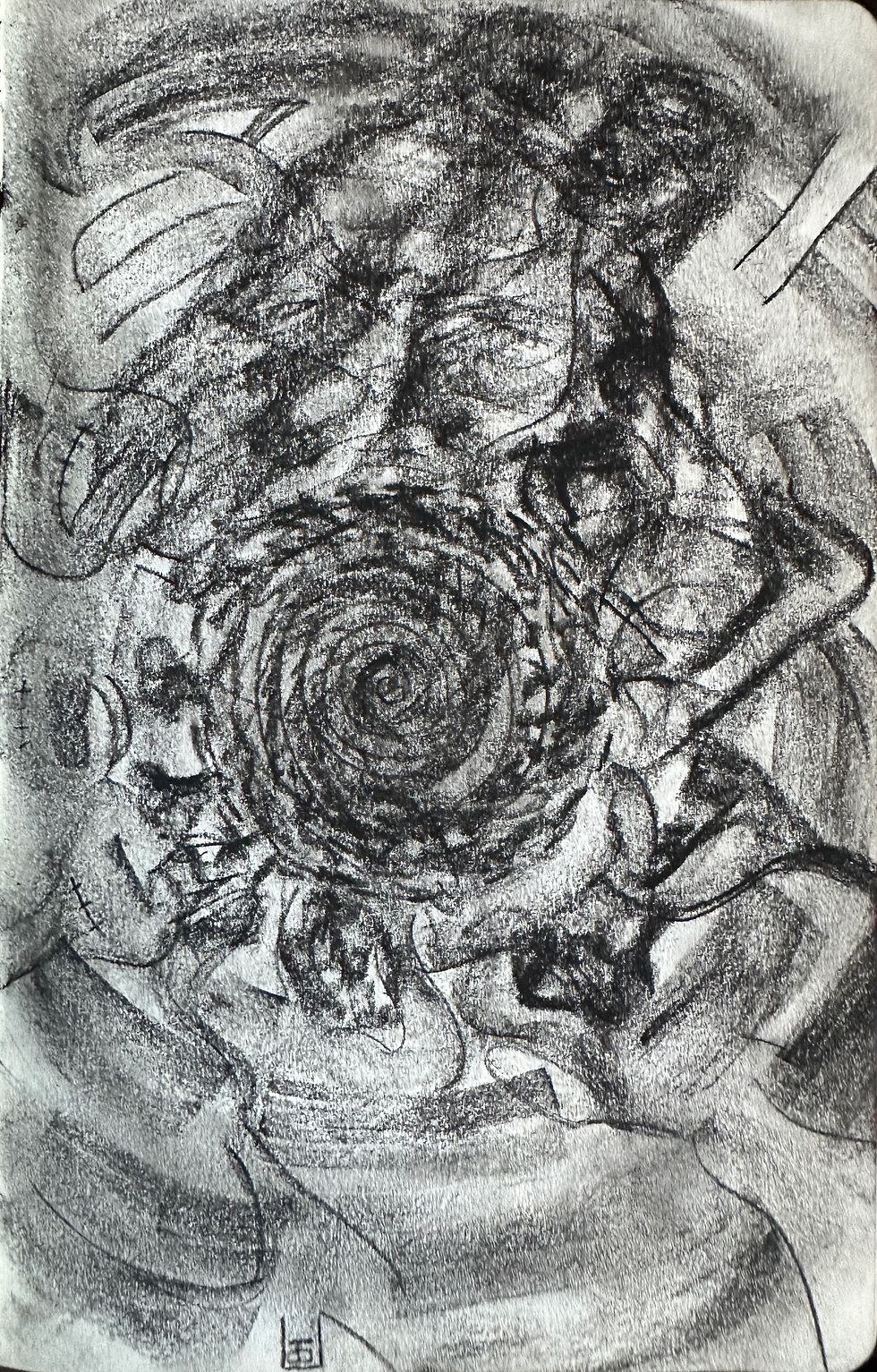
I wish to leave you with three images that index three modes of thinking – ontologies, epistemes, call them what you will, but my goal is to leave you with an aesthetic encounter. Whether you choose to pursue Ariadne’s thread to the heart of the cave of existence, I leave that unto you.

A snake biting its tail – capitalism and consumerism.

Two birds perched on a branch – one pecks at the fruit, the other watches – Dualism, Descartes, Upanishads

The empty seat under the Bodhi tree …
The road, Zhuangzi writes, was once a deserted place. It became a road because someone walked on it. If you take the same road all your life, it can become a rut in which the wheels of existence get stuck.
Wander easy and free!

Comments